Wednesday, 3 December 2008

Film Schedule

Film schedule 

This is the film schedule that we will be using in order to film our film outside of school hours. Beacause we only have the camera for the weekend. It is important that we organise our time and what scenes we are filming.    

Day                              Time                      Scene and location 

Friday 5th                  Night                     Indoors- Daniels bedroom 
December 

Friday 5th                  Night                     Indoors- Tims Kitchen        
December 

Sunday 7th                Day/evening         Outdoors- Drayton Green Park 
December 

Sunday 7th                Day/evening         Outdoors- Railway bridge 
December 

Sunday 7th                Day/evening         Outdoors- Railway bridge  
December 


Tuesday, 2 December 2008

Script Version 1

Here is a draft version of our script for our film "Obsession".


We will revise this and improve it as much as posible.


Monday, 1 December 2008

Our Synopsis

Here is a draft of our synopsis:
Be careful who your friends are...
Lucy, an innocent, life-loving girl on a simple walk home is unexpectidly kidnapped and placed in the boot of a car where she is driven by one of three men , who is  obsessed with her and needed her as a possession. Is she still alive after everything that happens and who has taken her? The desperate struggle of family and police looking for their missing daughter becomes a long and painful ordeal but is the way to finding their daughter easier than what it seems?

Tuesday, 25 November 2008

Location Scouting

Here are some of the pictures we have taken while all four of us went location scouting at the weekend. As you can see there are pictures of the railway bridge that we are thinking of using and also Tim and Daniel's bedroom as in one of the scenes there is an unknown male character in a bedroom. Shelley and Amy's bedrooms are unsuitable as they are too girly. Furthermore we at the end there are some pictures of the posible kitchens we will be using and also the part area in which one of our unknown characters will be seen.


Railway Bridge Images

This is the first image that is the entrance to the walkway towards the bridge.


This image shows further down the walkway, leading to the stairs of the bridge.

This image shows the beginning of the steps that lead up to the main walkway of the railway bridge.


This image shows a better view of the stairs, leading to the bridge.

This image shows the walkway across the railway line form the top of the stairs.

This image shows the walk through the tunnel of the bridge to the other side.

This image shows the steps on the other side of the bridge, going down.

This image shows the stairs going downwards on the other side of the railway bridge.

These final two images show the ending of the stairs as we reach the other side of the railway bridge. We have decided that this setting is perfect for a scene in which our main character is kidnapped and put into the boot of a car.


As mentioned earlier we have also taken some pictures of Tim and Daniel's bedrooms in order to distunguish which bedroom would be better to film in and whether it will fit in with the genre of our film.

The Bedrooms
Here are some pictures of Tim's bedroom:
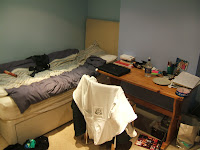

These images show a potential bedroom for our film.

Here are some pictures of Daniel's bedroom:


After looking at both of the bedrooms we have decided that Daniels bedroom would be better suited for filming in rather than Tim's. We feel that the shape of the room will be much easier to get the shot types that we want to show during the bedroom scene.


The Kitchens
Here are some of the pictures of Tims' kitchen, which we may use for one of our scenes.


These images show a potential kitchen for our film.

Sunday, 16 November 2008

Analysis of Opening Sequences Of Thriller Films

Analysis of Opening Sequences/Sequences in Thriller Films
By analysing the different opening s
equences we will be able to explore how the films we have analysed may be an influence on our own project.

London to Brighton
In the opening sequence, the title credits are straight to the point, it says the name of the film and the location and the time of the opening scene, this gives a quote realistic impression as we see that is in linear narrative and it is happening in the movement. so it gives a realistic gritty impression because it is happening in the moment. In one particular section, the girl is on her own in the toilet and all you can hear are people trying to break in through the door, her emotions are amplified, creating tension and suspense as the audience feels what the character feels. we see two characters that are on the run and turn to hide in the cubical of the toilet for safety. there is no use of musical score, just the digetic sounds of the door closing and then the dialogue within the two characters.
This creates tension, suspense and enigma because with the use of the door banging, this creates tension as there are people trying to get to them and with the use of no music s
core, thee is quite a violent atmosphere to it. the dialogue between the two characters is also a way to make the audience think and asks questions. Why do then need to run? They also mention characters that aren't in the scene and we don't know (for example Derek) so it creates enigma and we wonder who they are and what do they have to do with the two characters in the scene. this meets the typical expectations of the common thriller opening sequence because its creating enigma for the audience as they are trying to piece together what is happening within the opening scene. within the opening scene, the setting four times within three minutes. one of the characters goes from the cubical, to get some food, then going back to the cubical and then leaving again to get money, then back to the cubical and then going to the train station within three minutes of the film. this is elliptical editing and it meets the expectations of the typical thriller opening sequence because it keeps the pace and rhythm fast. this suggests to the audience the panic there was in getting to each place and creates tension as we can see the panic the character was in whilst going to the different places.

Written by Amy Cooper.


28 days later...
“28 days later...” is a prime example of a thriller opening sequence and uses many different devices to build tension and suspense. It is a low budget, English film but has had many successes. “28 days later...” has two halves to its opening sequence. The first half is edges more to the horror genre and so the second half is more significant due to its thrilling perspective. To understand what is going on the first half will briefly be explained. The film begins in the Cambridge Primate Research Centre as activists break in to free the chimpanzees. A scientist sees them and tries to call for security but is stopped. He tells them the chimps are infected with rage and they are infectious.
Even so, the cage is opened and one by one they are all infected by the virus. Then the second half of the opening scene begins with the title, “28 days later...” During this title, there is not quite silence, but some sort of background noise. The title is shown for about 10 seconds; these features are deliberate in order to allow the audience to take in what they have just seen and so they can think of the implications of it, which will be seen later. The first shot we see is an extreme close up shot of a half closed eye. This shot is used to disorientate the audience, which is very effective as you can even see the small hairs on his face and the audience does not know where the character is, and therefore this raises questions. With once breath we seen him brought back to life as his eye moves. At this point the shot is changed to a crane shot and we see he is a patient in a hospital that seems to be deserted. He gets up from his bed and tries to leave the room, shouting, “hello”. The camera changes so we can see a corridor in the hospital where there is an over turned bed. We see various scenes of the character walking around the hospital shouting “hello”, this confirms to the audience that it is in fact deserted; this begins to raise more questions on what happened. He then checks all the payphones and none of them are working, which continues the theme of a loss of communication. He then leaves the hospital and we see him walk around London, but not London as we know it. It is as if London has turned into a ghost town because there is no one in sight. We see our character cross London Bridge with the Houses of Parliament behind him as some very subtle non-diegetic score begins to play. Our character continues to walk across London, past an overturned bus, an empty Horse Guards Parade and Oxford Street. The score begins to quicken as our character finds many £20 notes. The music quickens and quickens as we enter the heart of the city and the character walks up to a stationary car in the middle of the road, and as he tries to open it, the alarm goes off. This diegetic sound creates a quick shock for the audience, making them jump out of their seats.He then walks over to a big pile of rubbish and a lot of newspapers. The non-diegetic score at this moment get a lot faster in a matter
of seconds, raising questions of what will happen next. He picks up an edition of the Evening Standard. The headline reads “EVACUATION” in large font, capital and bold le
tters. This suggests something terrible has happened. This is the answer the audience has been looking for. The pace of the music continues to quicken as he walks up to a billboard with hundreds of pictures of missing persons. He walks off with the board behind him as the score drowns out as the camera zooms in on a picture of a child.

Written by Tim Creedy


Indiana Jones and the Raiders of the Lost Arc

Indiana Jones and the Raiders of the Lost Ark is part of one of the most loved trilogies in the world and has been translated into many languages.
The film begins by showing wide angle scene of a mountain; after a few seconds a silhouette of Indiana Jones, the great archeologist, followed by a few accomplices. The film is set somewhere in South America in 1936. As the title credits emerge we see scenes of a jungle, which is dark (blues and blacks) and gloomy. The colour here represents a fear as many people a afraid of the dark. This already creates an atmosphere that there will be a lot of action in this film. Throughout these scenes we can hear sound effects of birds, monkey’s and other jungle animals. This makes the characters seem scared and nervous of what is beyond the path they are following.

The costumes the characters are wearing as seen as traditional jungle-wear. They have torn clothes, in bland colours such as beige and brown. This suggests that they have been through a lot as their clothes are ripped. The music quickens as an arrow in a tree is found. One of Indiana’s follows tests it for poison and it does have poison on it. This is a scary thought as others may be there which might jeopardise them getting the golden treasure they are looking for. They also find a statue at which one of the followers screams and sound effects are given in the form of birds screeching. After this the other followers look quite scared and frightened of the peril ahead. More animal noises are heard to create more suspense as they find the entrance to the tomb. They continue to walk and find the entrabce to the tomb. however before they enter there is a close up shot as Indinia Jones fills a bag of sand; this will be useful for later on. This makes the audience suspicious and wondering what the bag of sand is for. Inside the tomb the background noises are much quieter. The scenery inside the tomb is gloomy and very dark and there are cobwebs all over the place. Therefore as there are cobwebs, there are spiders and Indiana and his follower are then covered in them; thus creating more dramatic and suspenseful scene. They continue to walk down the tunnel as suddenly flying spikes struck their path. This sudden dramatic technique is followed up with typical shock music which in turn, makes the audience shocked, and the faint hearted may even jump out of their seats. Attached to the flying spikes is a dead body that is rotting; this reminds the audience how dangerous this mission is as this gives the perception that many others have failed. As they enter the main chamber dramatic music begins to play, this alerts the audience that the archeologist has found what he is looking for. Also when the camera shows a wide shot of the golden statue it shines brightly suggesting its importance. Many different types of shots are used to view the golden statue as again, it is an important part to the plot. As Indiana Jones walks up to the golden statue his is very careful of any traps that may be on the way; however he does find some, such as an arrow shooting out of as large grey statue, and these are examples of special effects – thus proving to the viewer just how dangerous this mission really is and it also reveals how brave Indiana Jones is. During this time relevant music is played which makes the audience nervous. The music builds up as Indiana Jones must take the statue and replace it with the bag of sand he collected earlier. However the weight is not correct and so the whole tunnel begins to collapse in. lots of close up and wide shots are used here to show the devastation and feelings of the archeologist. Overall this is a fantastic beginning to a fantastic film. It is exactly what you would expect from an action film such as this and no wonder so many people view it as a classic.

Written by Tim Creedy

Thursday, 13 November 2008

Ideas of Our Own Film

The purpose of straplines
Straplines, also known as taglines or a slogan, are used in order to leave a key message in the mind of the target audience but also to emphasise and re-enforce the brand identity. A good strapline should be memorable to its target and should be repeated to gain maximum effect.

Some examples of straplines include: Nike – just do it, Nokia – Connecting people and HSBC – The worlds local bank.

Examples of straplines from films
Reservoir Dogs: “Let’s go to work”
28 days later…: “His fear began when he woke up alone. His terror began when he realised he wasn't.”
London to Brighton: “Innocence has nowhere to hide.”
From Russia With Love: “The world's masters of murder pull out all the stops to destroy Agent 007.”

Some of our sample straplines
“There’s a thin line between love and hate”
“Watch your back…”
“You can run but you can’t hide…”
“They’re watching you.”
“Don’t let love lead to obsession”
"Obsession leads to possesion" 

Monday, 10 November 2008

Conventions of The Thriller Genre

The Conventions of the Thriller Genre
This area of research shows the typical devices, plot lines and characters that are typically used in thriller films.


What is a Thriller?
A thriller is usually something that creates tension. Within the text, there are plots to the twist of the story and there can be aspects of horror involved. A thriller should create question for the audience and also an sense of enigma (mystery) for the audience. A thriller should leave a chilling atmosphere and leave the audience feeling on edge.
Also there is an overlap with the mystery. However, thrillers are based around the hero thwarting the enemy rather than rather uncovering or solving an existing crime.


The difference between Horror and Thriller
These two genres have commonly been mistaken. For example if we look at the michael jackson video for his song 'Thriller' , it is branded as horror due to use of zombies which is often refered to as a sub-genre of horror. The horror genre tends to be more graphic making the audience feel more disgust rather than suspense or tension which is what the thriller genre does. The thriller genre should have the audience on the edge of their seats as the plot builds towards and intense climax.


Characters in Thrillers
Usually the main characters are often placed in menacing situations from which trying to escape seems impossible. Other characters include...
  • Ordinary People- Often ordinary people tend to be innocent and end up in bad circumstances in which escape seems impossible.

  • Damsel in Distress-

  • Femme Fatale- A female fatale is an alluring and seductive woman whose charm ensnares her lovers in bonds of irresistable desire often being led into dangerous or complicated situations.

  • Stalkers

  • Assasins

  • Police

  • Criminals/Fugatives

  • Characters that are involved within the government or politics for political thrillers.

The Common Themes used in Thrillers
The common themes that are used in thrillers are the plot lines. Many of these include..
  • Stalking/Voyenism

  • Mystery to be solved

  • Obessions

  • Espionage

  • Terrorism

  • Persuits

  • Dangerous Romantic liasons

  • Oppresive but unseen supernatural occurances

Common Cinematic techniques used in thriller films
Particular techniques are used in thrillers in order to create the tension and suspension that is required which is then leaving the audience feeling on edge due to what they see. Many of these techniques include...
  • Extreme zoom shots - Good for showing reactions and emotions. The extreme zoom shots get right in and shows the extreme detail. Can be used to show detail in which the human eye cannot usually see. or even to emphasize a key prop for dramatic effect.

  • Prolonged cross-cutting -

  • Quick of montage -

  • Use of Profile or silhouette -

  • Dolly zoom shots - A technique in which the camera moves closer or further from the subject while simultaneously adjusting the zoom angle to keep the object the same size in the frame. A very unnatural effect. It is used to create unease amongst the audience. One of the most famous examples of this was jaws.

  • Quick cutting - By quick cutting the film, it gives the thriller a faster pace and rythym which is what a normal thriller should do. For example, a car chase will have different and quick cuttings of each car chasing eachother and what happens. It is also with the use of elliptical editing that keeps the ryhtym and pace going however, makes it less realisitc and doesn't to keep to real timings.